Pierre Székely
A French sculptor of Hungarian origin, Pierre Székely was born in Budapest on 11 June 1923. A distinctive figure in the sculpture of the second half of the twentieth century, he developed a body of work at the intersection of abstraction, architecture and a humanist reflection on the role of art in society.
From 1941, he trained under the Hungarian artist Hanna Dallos and discovered stone carving during the Second World War. In 1946, he moved to France, where he settled permanently with Vera Harsányi, his future wife and artistic collaborator.
In 1948, Pierre and Vera Székely formed an artistic collective with the painter and ceramicist André Borderie. Based in Bures-sur-Yvette, they pursued a collaborative practice for a decade, exploring ceramics, sculpture, furniture and the integration of the visual arts into architecture. Influenced by Surrealism and biomorphic abstraction, their early works are distinguished by their freedom of form and poetic sensibility.
Closely aligned with the artistic explorations of Groupe Espace, Pierre Székely actively contributed to redefining the relationship between art and architecture. The house known as Le Bateau Ivre, created between 1953 and 1956 in Saint-Marcellin, and the redesign of the Saint-Nicolas church in Fossé in 1954 stand as major examples of this period.
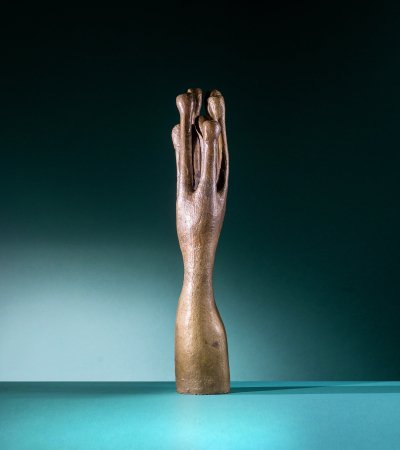
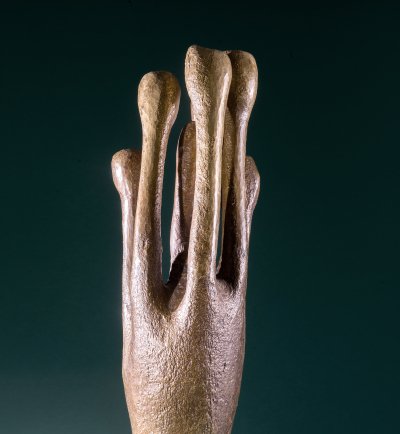
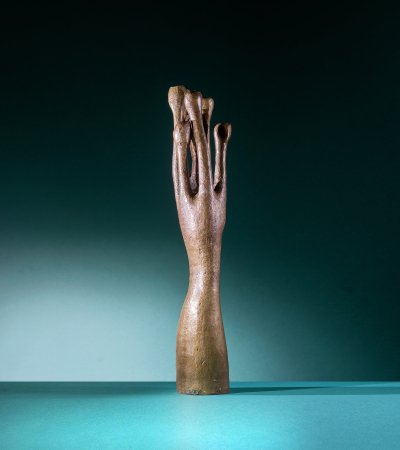
From the late 1950s onwards, Székely increasingly devoted himself to monumental sculpture. Working with stone, wood, ceramics, bronze and concrete, he developed a distinctive sculptural vocabulary characterised by pure, organic and symbolic forms. His sculptures evoke archaic signs and imaginary figures, reflecting his quest for a universal artistic language.
In 1966, he developed a flame-carving technique for granite, opening up new possibilities in monumental sculpture. In 1968, on the occasion of the Mexico City Olympic Games, he created Soleil bipède for the Route of Friendship. He also collaborated with architect Henri Mouette on the holiday village of Beg Meil and created the celebrated climbing sculpture La Dame du Lac in Évry.
In 1978, he was awarded the Grand Prix at the International Biennial of Street Arts. In 1981, the Monnaie de Paris devoted a major retrospective to his work. His career gained international recognition, particularly in Japan, where he created numerous monumental sculptures.
Appointed Knight of the Legion of Honour in 1998, Pierre Székely died in Paris on 3 April 2001.
His work, represented notably in the collections of the Centre Pompidou, reflects a lifelong ambition to bring artistic creation closer to humanity, architecture and nature. His sculptures from the 1950s are of particular historical significance, illustrating both the formative period of his distinctive sculptural language and the remarkable creative vitality of post-war France.