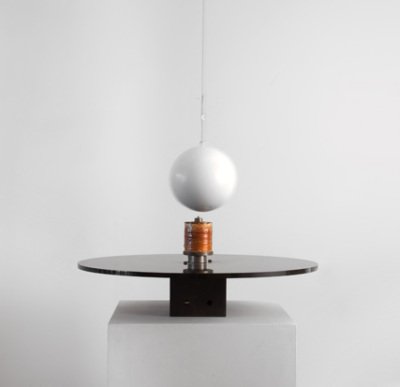
Takis
Born Panayiotis Vassilakis in Athens in 1925, Takis was one of the leading figures of the postwar European avant-garde. A self-taught artist, he left Greece in the early 1950s for Paris, where he became part of a highly experimental milieu shaped by abstraction and kinetic art.
By the mid-1950s, he developed his celebrated “Signals” — slender metal rods topped with vibrating elements — expressing a fascination with invisible forces. From 1959 onward, he introduced magnetism as a primary sculptural material. His works used magnetic fields to suspend, tension, and activate metallic forms, placing him at the forefront of kinetic and experimental art.
Takis lived and worked between Paris, London, and Athens, exhibiting internationally, including at the Venice Biennale and the Museum of Modern Art in New York. His practice explored energy, attraction, and unstable equilibrium — giving his sculptures a poetic dimension that bridges science and metaphysics.
In 1986, he founded the Takis Foundation – Centre for the Arts and the Sciences in Gerovouno, Athens, dedicated to research and the preservation of his work.