Sori Yanagi
Sori Yanagi (1915–2011) is one of Japan’s most influential 20th-century industrial designers.
Son of the famed Mingei philosopher Muneyoshi Yanagi, he developed his design philosophy within the ethos of Mingei— the belief that beauty and functionality should live inside everyday objects, available to all.
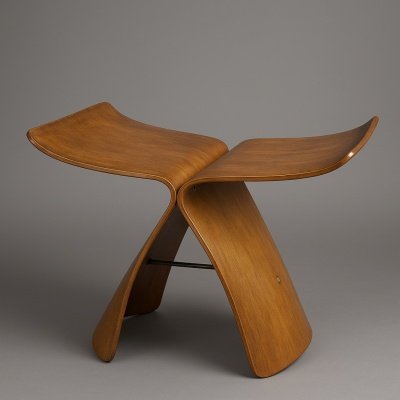
Yanagi championed a natural, minimalist, and human-centered approach to mass-production design. His most iconic creation, the Butterfly Stool (1954), consists of two symmetrical molded plywood shells joined at the center — a sculptural but honest object that changed the status of modern Japanese furniture worldwide. It soon entered the permanent collection of the MoMA, where it remains a defining symbol of post-war design innovation.
He worked extensively with the curved-plywood pioneer Tendo Mokko, producing chairs, tables, lighting, and tableware, always striving for simplicity of use and intuitive ergonomics.
In 1977, he was awarded the Ordre du Soleil Levant by the Japanese government for his cultural contribution to design.
Core belief: A good object explains its purpose through use, not words.