Claude Prévost
French designer Claude Prévost was active בעיקר during the 1960s and 1970s, a period marked by the renewal of postwar French design and its growing openness to international modernism. His work reflects this shift toward new materials, structural clarity, and a more rational approach to form.
Prévost is best known for his seating designs, in which he developed a distinctive and highly recognizable vocabulary. His armchairs and lounge chairs are characterized by chromed or tubular steel frames, combined with stretched leather seats and backs. The result is a refined balance between rigor and elegance, where the structure remains fully legible and the comfort carefully resolved. His aesthetic aligns with the broader modernist movement, while retaining a certain French sophistication in proportion and detail.
He collaborated notably with Maison Burov, a key publisher of modern furniture in France, for which he designed several models intended for both domestic and professional interiors. Through these collaborations, Prévost contributed to the dissemination of a functional yet elegant design language suited to contemporary lifestyles.
Alongside these edited pieces, he also developed more exclusive projects, particularly in connection with the fashion house Pierre Cardin. In this context, Prévost designed furniture and participated in the creation of interiors with a distinctly futuristic and experimental character, in line with Cardin’s avant-garde vision in the late 1960s and 1970s. These collaborations illustrate a close dialogue between fashion, interior architecture, and design, where furniture becomes an integral part of a broader spatial concept.
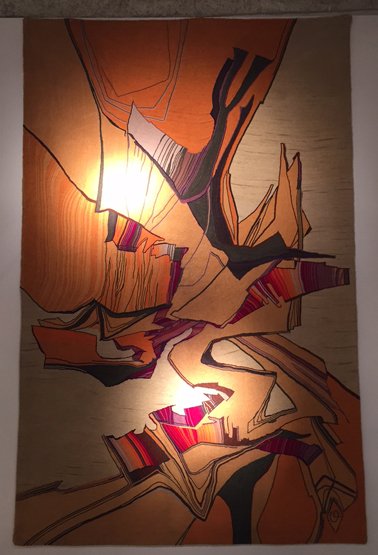
Beyond furniture, Claude Prévost also explored tapestry as an artistic medium. His textile works, often composed of abstract compositions and geometric rhythms, extend his research on structure and space into a more pictorial dimension. Through tapestry, he engages with color, texture, and material in a freer and more expressive manner, complementing the formal rigor of his metal furniture.